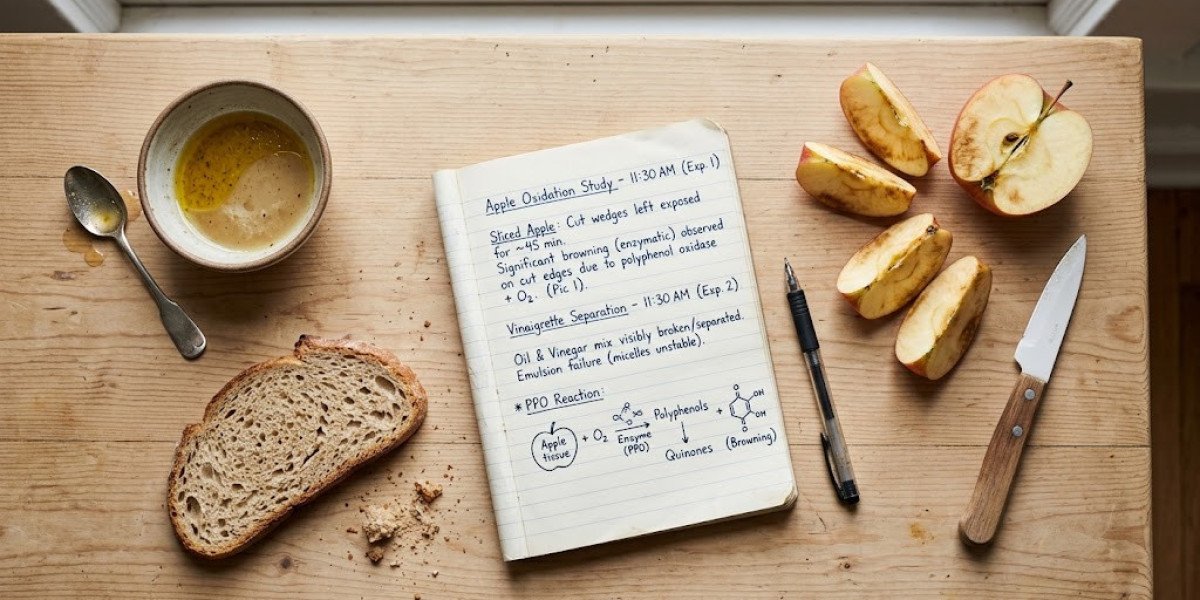

You're staring at a food sample, a page of results, and a question asking you to explain what happened. The result looks simple enough bread went hard, fruit went brown, a sauce split overnight. But the moment you try to explain why, the simplicity disappears.
That's because food isn't one thing behaving one way. It's water, protein, fat, sugar and enzymes all sitting together, quietly influencing each other. The real skill isn't memorising reactions. It's working out which factors actually matter in the situation in front of you, and explaining how they connect without turning the answer into a list of vocabulary.
A strong explanation walks the reader from what was seen, to what caused it, to the proof behind it and stays honest about where the evidence runs out.
Start With What Actually Happened
Most people rush this bit. Say a yoghurt sample turns sharper and more acidic after a week in storage. Writing "the pH dropped" is true but useless on its own. The real question is what produced that drop fermentation, ongoing microbial activity, or a shift in the food's environment, depending on the product.
Texture works the same way. A loaf firms up on day two, and it's tempting to just write "it dried out." Moisture loss is sometimes part of it, but starch is also reorganising itself, and water is redistributing inside the crumb regardless of weight loss. The everyday observation is real; what's underneath it is a lot busier.
This is exactly the level of thinking food science and nutrition modules expect once you're past the basics which is often where students end up searching for food science assignment help UK, less because they lack the theory, and more because nobody's shown them how the pieces actually fit together.
Where People Go Wrong
The problem usually isn't a lack of knowledge. It's stopping at the first explanation that sounds plausible.
Take a cut apple browning on the counter. "Oxygen causes oxidation" sounds scientific enough, but it skips the enzymes doing the actual work and the tissue damage that let the reaction show up. A better answer asks why cutting the apple changed its environment in the first place.
There's also a trap with numbers. A result measured to two decimal places looks rock solid, but precision says nothing about whether the interpretation is right. The method, sample and controls still matter, decimals or not. After every result, pause and ask what it actually proves versus what you're quietly assuming.
The Ideas Worth Knowing
Food composition is the starting point. Water controls how mobile everything else is; proteins hold structure together; carbohydrates take part in physical and chemical change; fats carry flavour and oxidise easily. Shift one, and something else in the system usually moves too.
Food chemistry explains what that shift looks like oxidation, protein denaturation, starch gelatinisation, enzymatic browning. What matters is whether the reaction you've named actually explains the result in front of you, not just that you can spell it correctly.
Biology comes in wherever living organisms are involved temperature, pH, moisture and oxygen all shape microbial behaviour, and enzymes can alter food long before anything microbial gets involved. Processing ties it together: heating, freezing, drying and fermenting all change the conditions chemistry and biology operate under, which is why one processing decision can affect texture, flavour and safety at once.
What to Actually Look At
Start with what the food contains a protein-heavy food likely needs a different explanation to a starch-based one behaving similarly. Composition doesn't hand you the answer, but it narrows down what's worth taking seriously.
Then look at what was done to it. Temperature, time, pH, moisture, oxygen and packaging can all shift the outcome, and a product often keeps changing after processing finishes storage time isn't background noise.
It's also worth separating quality, nutrition and safety, since they don't move together. A colour change might just put people off buying it without meaning it's unsafe. Something can look normal and still need a proper check. Each claim needs its own evidence, not one shared assumption.
A Practical Way Through It
When a question feels like a mess, take the result apart first, in plain language: firmness dropped, pH rose, colour darkened, microbial count rose. Naming it properly usually shows which science is actually relevant.
List more than one possible cause before committing to any. A split sauce could involve emulsification failure, temperature, mixing, or ingredient ratios rarely just one on its own. Then match each possible mechanism against the evidence you actually have, and write it as though explaining to someone who knows the basics but hasn't seen how they connect yet.
Mistakes Worth Dropping
Listing every relevant-sounding theory doesn't make an answer analytical each one needs a real reason for being there. Treating one variable as the whole story is another common slip; temperature might matter most, but its effect usually depends on time and moisture too.
Watch correlation versus causation as well. Two measurements moving together suggests a relationship, not proof of the mechanism. And don't hide genuine uncertainty to sound confident "the results are consistent with..." is often the more rigorous sentence, not the weaker one.
Bringing It Together
A strong food science explanation should leave the reader feeling the result finally makes sense, not just handed a pile of new terminology. Start with the observation, move into composition and mechanism, bring in the processing conditions, then check it all against the evidence honestly.
That chain problem, observation, mechanism, evidence, interpretation is what turns a confusing lab result into something you can actually explain to someone else. And that, more than knowing every possible answer, is the real skill.