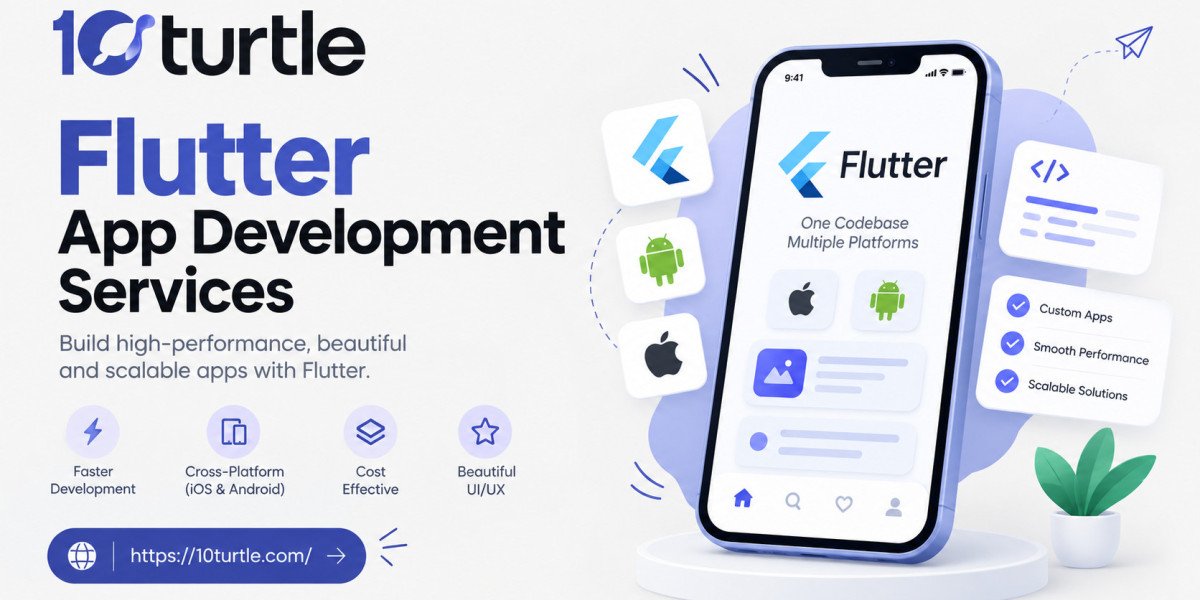

If you're evaluating flutter app development services for your next mobile project, you're in good company. Flutter has become one of the most widely adopted frameworks for building apps that run smoothly on both iOS and Android from a single codebase.
For USA businesses juggling tight timelines and even tighter budgets, that single-codebase approach is a real advantage. Instead of building and maintaining two separate native apps, a flutter development company can ship one codebase that behaves like a native app on both platforms usually in less time and for less cost than a fully native build.
This guide breaks down why Flutter matters for businesses, what to look for in a flutter app development company, what a typical project costs, and how to choose the right partner. Whether you're a startup building your first MVP or an enterprise modernizing a legacy app, the goal here is to give you a practical, no-fluff starting point.
Why Flutter App Development Matters for Businesses
Flutter, built and maintained by Google, uses the Dart programming language to compile apps into native ARM code. That means the end user isn't interacting with a "wrapped" web app they're using something that looks, feels, and performs like a true native application, on both iOS and Android.
For business owners, the appeal isn't the technology itself it's what the technology enables: faster releases, lower long-term maintenance costs, and a consistent user experience across devices.
Key Benefits
- One codebase, two platforms: A single Flutter codebase typically covers both iOS and Android, cutting development time significantly compared to building native apps separately.
- Faster time to market: Flutter's hot-reload feature lets developers see changes instantly, which speeds up testing, iteration, and overall delivery.
- Consistent UI across devices: Flutter renders its own widgets rather than relying on platform components, so your app looks the same on every screen size and OS version.
- Lower long-term cost: Maintaining one codebase instead of two (Swift/Kotlin) generally reduces ongoing development and QA costs.
- Strong performance: Because Flutter compiles to native code, apps tend to run smoothly even with animations, transitions, and data-heavy screens.
Common Business Use Cases
Companies across industries use Flutter for a wide range of products:
- E-commerce apps that need fast load times and consistent checkout flows across devices
- On-demand and delivery platforms requiring real-time tracking and notifications
- Fintech and banking apps where security and native-like performance both matter
- Healthcare apps for patient portals, appointment scheduling, and telehealth
- Internal enterprise tools that need to run on both company-issued iOS and Android devices
- MVP builds for startups that need to validate an idea quickly before scaling
[INTERNAL LINK: /services/mvp-development "MVP app development services"]
Important Factors to Consider Before You Start
Before signing off on a project, there are a few practical questions worth answering — regardless of which flutter app development company you choose to work with.
Cost and Implementation Timeline
Flutter app development cost varies widely depending on scope, but a few factors consistently move the number:
- App complexity — a simple MVP with a handful of screens costs far less than an app with real-time data, payments, or complex integrations.
- Design requirements — custom UI/UX design work adds time compared to using established design systems.
- Third-party integrations — payment gateways, maps, push notifications, and backend APIs all affect scope.
- Team structure — an in-house team, a freelance developer, and a dedicated agency each come with different cost and risk profiles.
A basic MVP typically takes 6–10 weeks, while a mid-complexity app with custom backend logic can take 3–6 months. Enterprise-grade apps with heavy integrations often run longer. Getting a detailed scope and timeline from your provider upfront avoids surprises later.
Technology and Integration
Flutter apps still need to talk to the rest of your stack your backend, your analytics tools, your CRM, your payment processor. Before you start, it's worth confirming that your chosen team has experience with:
- REST or GraphQL API integration
- Firebase or custom backend services
- State management approaches (Provider, Riverpod, Bloc)
- App Store and Google Play submission requirements
- Ongoing maintenance and OS/SDK update support
How to Choose the Right Flutter App Development Company
Not every flutter development company is the right fit for every project. A few things worth checking before you commit:
- Portfolio relevance — Have they built apps in your industry or with similar complexity?
- Team structure — Will you work with dedicated Flutter developers, or a generalist team picking up Flutter as needed?
- Communication process — USA-based businesses often benefit from overlapping working hours and clear, regular check-ins.
- Post-launch support — Ask how they handle bug fixes, OS updates, and feature additions after launch.
- Transparent pricing — Fixed-bid vs. time-and-materials pricing each carry trade-offs; make sure you understand which model you're agreeing to.
Many businesses choose to hire flutter developers through an established agency rather than individually, since an agency typically brings project management, QA, and design support along with the engineering talent.
Frequently Asked Questions
What is Flutter app development?
Flutter app development is the process of building mobile, web, and desktop applications using Google's Flutter framework and the Dart programming language. A single codebase can be compiled into native apps for iOS, Android, and other platforms.
How much does Flutter app development cost?
Cost depends on app complexity, design needs, and integrations. A simple MVP might start in the low five figures, while feature-rich or enterprise apps can run considerably higher. Getting a scoped quote from a flutter app development company is the most reliable way to get an accurate number for your specific project.
Why is Flutter a good choice for app development?
Flutter lets teams build for iOS and Android from one codebase, which usually means faster development, easier maintenance, and a more consistent user experience without sacrificing native-level performance.
How long does it take to build a Flutter app?
A basic MVP typically takes 6–10 weeks. More complex apps with custom backends, integrations, or advanced UI can take 3–6 months or longer, depending on scope.
Do I need separate teams for iOS and Android with Flutter?
No that's one of the main advantages. A single Flutter development team can build and maintain the app for both platforms simultaneously, which reduces both cost and coordination overhead.