
Definition
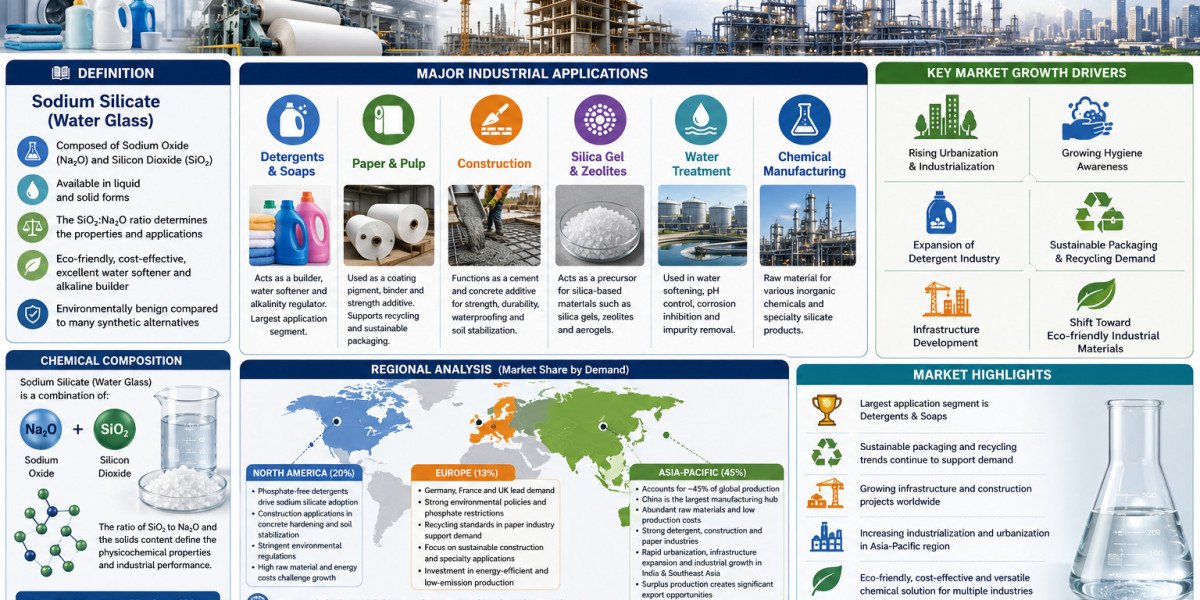
Sodium silicate, often referred to as water glass, encompasses a group of compounds derived from soluble silicate glasses. Chemically, it is composed of sodium oxide (Na₂O) and silicon dioxide (SiO₂) combined in various ratios, producing either liquid or solid forms depending on the concentration and formulation. The ratio of SiO₂ to Na₂O, along with the solids content, defines the physicochemical properties of the compound, allowing it to cater to diverse industrial applications.
Industrially, sodium silicate plays a pivotal role as a multifunctional chemical. Its primary functions include acting as a builder in detergents, a binder and strength enhancer in paper production, a cement and concrete additive in construction, and a precursor for silica-based materials such as silica gels, zeolites, and aerogels. The compound is widely valued for its cost-effectiveness, water-softening properties, alkalinity maintenance, and environmentally benign profile compared to many synthetic alternatives.
The production process generally involves the fusion of silica sand with soda ash at high temperatures, followed by dissolution in water to form a liquid solution or solid granules. Sodium silicate is classified into liquid and solid forms, each with specific industrial advantages. Liquid sodium silicate is preferred for ease of handling, transport, and industrial integration, while solid sodium silicate finds applications where storage stability and concentrated dosing are required.
Its extensive utility spans across multiple sectors including detergents and soaps, construction, paper and pulp, adhesives, and emerging sustainable technologies. Sodium silicate’s versatility, combined with its chemical stability and environmental advantages, underpins its continued relevance in modern industrial applications.
Get FREE Sample of this Report at https://www.intelmarketresearch.com/download-free-sample/13682/sodium-silicate-market
Market Size
The global sodium silicate market was valued at USD 2.02 billion in 2024 and is projected to grow to USD 2.29 billion by 2032, reflecting a compound annual growth rate (CAGR) of 1.9%. The modest growth is primarily driven by the stable demand from core industrial sectors such as detergents, construction, and paper manufacturing.